Fact Check
Hanoi up close: fact-checking a viral travel vlog about Vietnam
What the video says
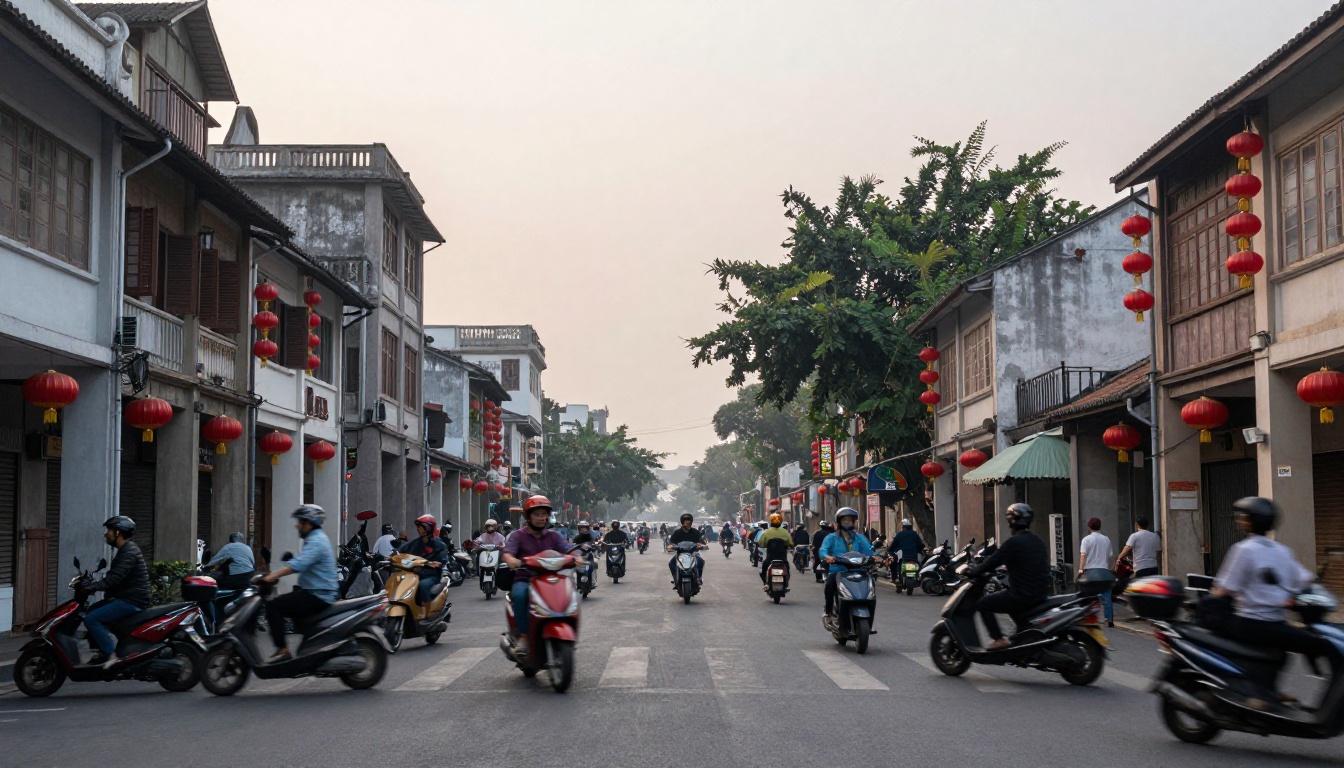
A travel vlog from Spanish-language YouTube channel Araya Vlogs walks viewers through Hanoi, the capital of the Socialist Republic of Vietnam, painting it as one of the world’s cheapest, most densely populated and most chaotic cities. The host describes a country of more than 100 million people with 58 million registered motorcycles, sidewalks given over to parked scooters, and an air-pollution problem so heavy that distant buildings disappear into the smog.
He tells viewers Vietnam is “one of the five communist countries in the world,” that the government wants to phase out gasoline engines in the center of Hanoi, and that Train Street, where homes and cafes sit inches from an active rail line, was once nearly shut down for safety reasons. He also describes Cao Dai, an unusual religion that he says venerates Jesus, the Buddha and Confucius and is found “only in Vietnam,” and reports openly visible dog-meat restaurants whose owners covered his camera when they noticed him filming.
Most of these claims line up with what international reporting and official sources show, but a few of the headline numbers are out of date and one of the religion claims needs a trim. Below is a closer look.
Checking the claims
Claim 1: Vietnam is one of “the five communist countries in the world.”
Verdict: TRUE
Reference works that track political systems consistently list five remaining single-party communist states: the People’s Republic of China, Cuba, Laos, North Korea and Vietnam. Britannica’s reference entry on the question lists those same five as the world’s surviving communist countries, noting that each blends one-party rule with locally adapted economic policies. Vietnam in particular has been governed by the Communist Party of Vietnam since national reunification in 1975 and remains a one-party state, even as it allows extensive private enterprise and foreign investment.
The vlog’s offhand observation about Hanoi feeling more open than expected, with private businesses and Western chains operating freely, is also broadly accurate. Vietnam’s “socialist-oriented market economy” allows companies like Starbucks, McDonald’s and KFC to operate while the Communist Party retains exclusive political power.
Sources: - Which countries are communist? — Britannica - List of communist states — Wikipedia
Claim 2: Vietnam has more than 100 million people, and Hanoi has more than 8 million.
Verdict: TRUE
Vietnam’s population crossed the 100 million mark in 2023 and is estimated at roughly 101 to 102 million in 2025, according to United Nations and World Bank data compiled by trackers such as Worldometer and the World Bank’s open data portal. The country is one of the most densely populated in mainland Southeast Asia.
Hanoi’s most recent population estimates put the capital at roughly 8.8 million residents in 2025, consistent with the “more than 8 million” figure cited in the video. Macrotrends, drawing on UN urban-population data, shows the metro area has been among the fastest-growing in Southeast Asia for two decades.
Sources: - Vietnam Population — World Bank Data - Ha Noi metro area population — Macrotrends
Claim 3: Vietnam has more than 58 million registered motorcycles.
Verdict: PARTIALLY TRUE — the video understates the figure
The “58 million” number was accurate several years ago but is now well behind the current count. State-affiliated outlet VietnamNet reported in November 2024 that Vietnam had crossed 77 million registered motorcycles as of September 2024, citing Ministry of Public Security data, with a motorcycle ownership rate of about 770 per 1,000 people. More recent reporting from automotive trade publications puts the count above 80 million by late 2025, though figures vary depending on whether they include mopeds and inactive registrations.
Either way, the underlying point in the vlog is correct: roughly four out of five Vietnamese residents have a motorcycle, and the country leads the world in motorcycle ownership per capita. The vlog’s description of sidewalks used as parking and pedestrians forced into the street is consistent with reporting from Reuters and other outlets that have covered Hanoi’s traffic for years.
Sources: - Vietnam leads the world in motorcycle usage with over 77 million registered — VietnamNet - Motorcycle market in Vietnam — Statista
Claim 4: Hanoi is one of the most polluted cities in the world, and the government plans to remove gasoline engines from the center.
Verdict: TRUE
Air-quality monitor IQAir, which compiles real-time and annual rankings of the world’s most polluted major cities, has repeatedly placed Hanoi at or near the top of its global rankings during the 2024 and 2025 seasonal pollution peaks. In its October 5, 2025 newsroom bulletin, IQAir reported that Hanoi was the most polluted major city in the world that day, with an Air Quality Index reading of 164 — well into the “unhealthy” range. A December 3, 2025 update again ranked Hanoi among the top 10 most polluted major cities globally, and Vietnam’s national news service VnExpress reported a December cold-season smog episode that pushed PM2.5 readings to dangerous levels for several days.
The vlog’s claim that Hanoi plans to phase out gasoline engines in the city center is also confirmed, though the policy is more nuanced than a flat ban. According to VnExpress International and Vietnam’s state news agency VNA, starting July 1, 2026, Hanoi will impose time-based restrictions on gasoline-powered motorbikes inside Ring Road 1, the innermost ring of the capital. The restrictions cover nine central wards initially, expand to Ring Road 2 areas in 2028, and extend to 36 wards inside Ring Road 3 by January 1, 2030. Cars that do not meet Euro 4 emissions standards and large gasoline or diesel trucks will face similar limits.
Sources: - August 14, 2025: Hanoi among top 10 most polluted major cities — IQAir - Hanoi to ban gasoline motorbikes during specific hours starting July 2026 — VnExpress - Hanoi plans time-based ban on gasoline-powered motorbikes from 2026 — Vietnam News Agency
Claim 5: Hanoi’s “Train Street” is a famous, dangerous attraction that the government tried to close.
Verdict: TRUE
Train Street is a stretch of active railway in central Hanoi, lined with cafes and homes that sit just feet from the rails. Train drivers reported having to make emergency stops as crowds of tourists posed for photos, and on October 6, 2019 a local train was rerouted because the street was too packed. The government ordered cafes and stalls along the tracks to close shortly afterward and put up barriers, an episode covered by TIME and reflected in the Wikipedia article on the street, both of which describe the closure as a safety response rather than a permanent shutdown.
The street reopened to tourists in early 2023 with stricter rules: visitors must sit inside cafes when a train approaches and stay off the rails, and security staff sweep the area before each scheduled passage. Daily Sabah and other outlets have continued to document near-misses, including a 2024 incident in which a tourist climbed onto the rails for a photo. The vlog’s description of staff clearing tourists, tables and chairs minutes before the train arrives is consistent with how the site currently operates.
Sources: - Why Hanoi Wants Tourists to Stop Visiting One of Its Most Popular Attractions — TIME - Hanoi Train Street — Wikipedia
Claim 6: The Cao Dai religion blends Christianity, Buddhism and Confucianism, and is “only found in Vietnam.”
Verdict: PARTIALLY TRUE
The description of Cao Dai’s beliefs is accurate. According to Britannica, Caodaism was formally established in 1926 in southern Vietnam by civil servant Ngo Van Chieu, and it is openly syncretic: it draws ethical precepts from Confucianism, occult practices from Taoism, ideas of karma and rebirth from Buddhism, and a hierarchical structure (including a pope) from Roman Catholicism. Its pantheon includes the Buddha, Jesus Christ, Lao-Tzu, Confucius and even Joan of Arc and Victor Hugo, and God is symbolized as an eye within a triangle.
The vlog’s claim that Cao Dai is found “only in Vietnam” is too strong. The religion’s headquarters is the Tay Ninh Holy See in southern Vietnam, and the vast majority of its estimated four to six million adherents do live in Vietnam. But Britannica and academic sources also document Cao Dai communities in Cambodia, France, Australia and the United States, founded largely by Vietnamese refugees after 1975. Stanford’s Asia-Pacific Research Center has hosted public lectures specifically on Cao Dai’s diaspora congregations in California.
Sources: - Cao Dai — Britannica - Caodaism — Wikipedia
Claim 7: Dog-meat consumption is openly visible in Hanoi but declining among younger Vietnamese.
Verdict: TRUE
Dog meat has historically been part of regional Vietnamese cuisine, especially in the north, and is still sold in some neighborhoods, restaurants and rural markets. Wikipedia’s overview, drawing on academic and NGO sources, reports that consumption has been declining for years and that surveys show majority public support for ending the practice — one 2021 survey put support for a full ban at roughly 90%. Animals Asia and Humane World for Animals, which have long campaigned on the issue, report similar numbers, with two-thirds or more of Vietnamese adults backing a ban on the trade.
In 2018 Hanoi’s authorities publicly said they would phase out dog and cat meat in the city’s central districts by 2021, citing both rabies risks and Hanoi’s image as a tourist destination. Reporting by Southeast Asia Globe and other outlets shows that ban was never formally enforced and that dog-meat restaurants are still operating in parts of the capital, though the trade has shrunk and shifted southward into provinces like Nghe An and Thanh Hoa. The vlog’s description — restaurant owners covering the camera, the host noting that consumption is decreasing among younger urban Vietnamese — matches the picture in independent reporting.
Sources: - Dog meat consumption in Vietnam — Wikipedia - What happened to Hanoi’s dog meat ban? — Southeast Asia Globe
Claim 8: One US dollar equals about 26,000 Vietnamese dong.
Verdict: TRUE
The vlog’s exchange-rate figure is essentially correct as of this writing. Trading Economics and the Vietnam News Agency’s currency tracker show the official USD/VND rate hovering around 26,328 to 26,359 dong per US dollar in late April 2026, with parallel “free market” rates running about 200 to 300 dong higher. The dong has weakened modestly against the dollar over the past year, by about 1.3%.
For US travelers, that means a 500,000-dong note — the largest denomination in regular circulation — is worth roughly $19, and the host’s reported $30 hotel night, $4 noodle bowl and $1 lemon tea translate cleanly into the prices a visitor would actually see today.
Sources: - Vietnamese Dong — Trading Economics - USD to VND historical rates — Wise
Bottom line
The Araya Vlogs tour of Hanoi is mostly accurate. Vietnam is genuinely one of the five remaining communist countries, the population and Hanoi metro figures hold up, and the picture of a city dominated by motorcycles and seasonal smog is consistent with international air-quality data and Vietnamese government policy responses. The capital’s planned restrictions on gasoline-powered motorbikes inside Ring Road 1 starting in July 2026 are real and on the calendar, though the policy is a phased, time-based set of restrictions rather than the immediate full ban a casual viewer might infer.
Two details are worth correcting. The motorcycle count cited in the video — “more than 58 million” — is roughly 20 million low; Vietnamese government data put the figure above 77 million by late 2024 and above 80 million by 2025. And while Cao Dai is overwhelmingly a Vietnamese religion, it is not exclusively Vietnamese: small but established congregations exist in Cambodia, France, Australia and the United States. Travelers planning a trip to Hanoi should also know that Train Street remains open but tightly managed, and that Vietnamese authorities are actively shifting transport policy in ways that could meaningfully affect rideshare, motorbike-taxi and rental options inside the city center over the next several years.